 booking@myprivatevillamarrakech.com
 +212 6 94 20 06 00


What Are the 5 Essential Points to Check in a Short-Term Rental Contract in Morocco?
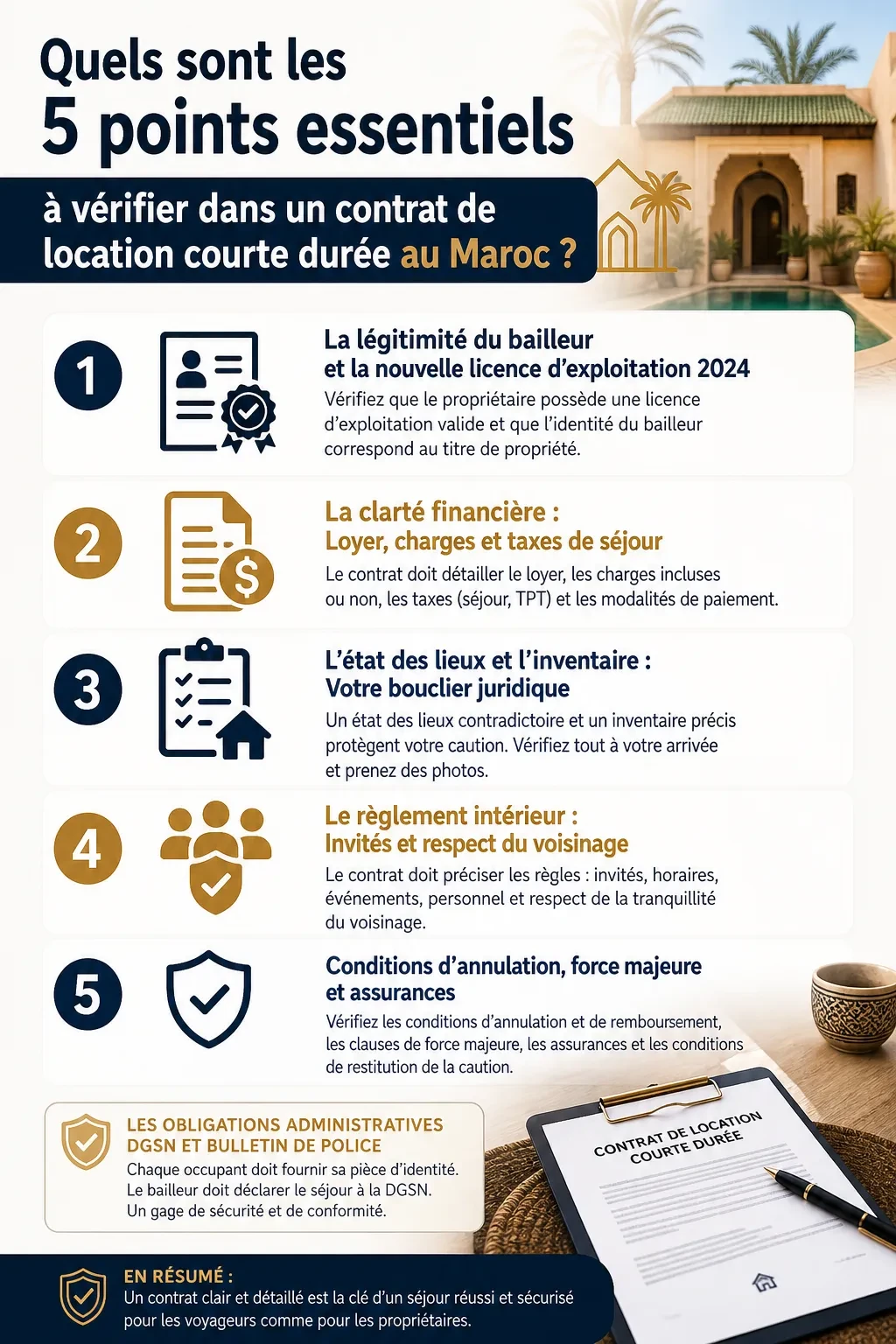
What Are the 5 Essential Points to Check in a Short-Term Rental Contract in Morocco?
Are you wondering which crucial points to verify before confirming your stay? To answer you directly, here are the 5 pillars of a secure agreement: the landlord’s legitimacy (operating license), transparency regarding rent and taxes, the precision of the inventory (state of play), house rules (guests and noise), and the specific cancellation and security deposit conditions.
Whether you are a traveler looking for a villa rental in Marrakech or a landlord wishing to protect your property, a well-drafted short-term rental contract in Morocco is your best legal guarantee. This document, governed by strict new laws, transforms a simple reservation into a professional and serene agreement.
1. Landlord Legitimacy and the New 2024 Operating License
Your first instinct should be to verify that the person you are dealing with has the legal right to rent. Since the enforcement of Law 80-14, holiday rental in Morocco has become strictly regulated. Every property owner must now hold an operating license issued by local authorities (the Wali or the Governor).
A serious short-term rental contract in Morocco must mention this authorization. Why is this vital? Because in the event of an inspection or a legal dispute, a contract without a license may be considered null and void. Also, ensure that the owner's identity matches the property title or that a clear management mandate links the agency to the real estate. At My Private Villa Marrakech, we guarantee total transparency for every property in our portfolio.
2. Financial Transparency: Rent, Fees, and Tourist Taxes
The advertised price should not hide any unpleasant surprises. The contract must detail the rental amount, but also which charges are included (electricity, pool heating, house staff).
A point often overlooked in a holiday rental in Morocco concerns local taxes. The Tourist Tax and the Tourist Promotion Tax (TPT) are mandatory. The contract must specify whether these fees are already included in the price or if they must be paid upon arrival. Similarly, clearly define the payment terms: the deposit required at booking and the balance due before check-in.
3. The Inventory and Furniture List: Your Legal Shield
Never sign a short-term rental contract in Morocco without a clause providing for a contradictory inventory (state of play). This document, annexed to the contract, protects your security deposit.
The landlord must perform a precise inventory of the furniture and equipment (air conditioning, Wi-Fi, kitchen appliances). As a tenant, take the time to verify that everything works upon your arrival. For a high-standing villa rental in Marrakech, time-stamped photos are your best allies. They serve as indisputable evidence when it comes to the restitution of the security deposit at the end of your stay.
4. House Rules: Guests and Neighborhood Respect
This is often where conflicts arise. Contracts for holiday rental in Morocco include specific clauses regarding expected behavior.
Check the following points:
External Guests: Are they allowed? If so, until what time?
- Events: Are parties and loud gatherings prohibited?
- Staff: What are the working hours for the cook or the caretaker?
Respecting the neighborhood's peace is a priority for Moroccan authorities. A breach of these rules can lead to the immediate termination of the contract without a refund.
5. Cancellation Policies, Force Majeure, and Insurance
Life is full of unexpected events. Your short-term rental contract in Morocco must include a clear cancellation clause. What are the deadlines for a partial or full refund? What happens in case of force majeure?
Furthermore, check the clauses relating to insurance. The owner must have comprehensive home insurance covering tenants. On your side, ensure that your personal liability insurance covers accidental damage during your vacation. A well-drafted clause regarding the security deposit will also specify the refund timeframe (usually between 2 and 7 days after departure).
Administrative Obligations: DGSN and Police Forms
Beyond the contract, Moroccan law requires the landlord to declare their guests. Each occupant must provide a copy of their ID to fill out the "individual police form" intended for the General Directorate of National Security (DGSN). This formality is further proof that you are staying in a compliant structure. Do not be surprised if this request appears explicitly in your short-term rental contract in Morocco.
Why Choose a Professional Property Management Agency?
Managing a holiday rental in Morocco requires sharp expertise in local laws and constant reactivity. By choosing a specialized agency like My Private Villa Marrakech, you grant yourself peace of mind. We use legally validated contract templates, handle administrative declarations, and ensure rigorous follow-up of the property's condition.
In conclusion, a solid short-term rental contract in Morocco is the foundation of a successful stay. It defines the rights and duties of each party, transforms expectations into commitments, and protects the financial interests of both the landlord and the tenant. Before unpacking your bags, take a few minutes to read and validate these 5 essential points.